Costume
jewellery can enliven a fashion wardrobe and bring a dash of panache especially
for one off special occasions. Costume jewellery can be superb. The superb is
usually plated at least seven times with 18 or 22 ct gold. For example Joan Rivers does a range of good costume jewellery
modelled on original fine gem pieces. One of her trademarks is to make jewellery
doubly useful and she produces sets of interchangeable earrings, pendants and
tennis bracelets. For example you might be able to slip a range of up to 10
different coloured stones, pearls or Swarovski crystals into an 18ct
gold plated earring to vary the look. Her jewellery is exclusive to the QVC
shopping channel in the UK and she is constantly working on new ideas such is
her enthusiasm. Highest grade Cubic
Zirconium man made imitation diamonds often set in precious metals is of such a
good standard that almost everyone can afford to have attractive jewellery. The best
crystals used in costume jewellery are the first grade crystals that the top Austrian firm Swarovski
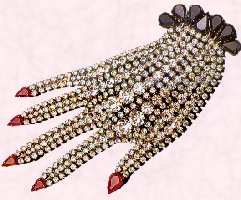
can offer. Butler and Wilson costume brooch.
Some of
the costume jewellery I have come to love, comes from companies like Ciro, Adrian
Buckley, Butler and Wilson, Swarovski Crystal Jewelry Napier, Joan Rivers, Joan
Collins, Christian Dior, California Crystal, Property of A Lady and of course Kenneth J Lane.
Jewels have always been used as love tokens and whilst many pieces were fine gems and precious metals, good fake jewellery intended to deceive existed. True gemstones and pearls originated from the east and were bought chiefly by the Italians. The Italian merchants then sold the goods on in Europe. Good glass imitations were often used and sometimes with intent as in royal funerary robes and children's jewellery.
Flawless, round, natural, large white pearls were prized more than precious gemstones. The finest of pearls were provided by South India and the Persian Gulf, see good examples of pearl jewellery. The Italians, particularly the Venetians and people from Murano, could make imitation glass gems and pearls that were very good likenesses of the real jewels. Recipes for false pearls existed in 1300 when white powdered glass mixed with albumen (egg white) and snail slime, produced beads that were used as imitation pearls.
The new design philosophy of Arts and Crafts that sprang up
after 1870 was a reaction to mass produced goods and inferior machine made
products. It was a reaction to the shoddy interior and ornamental products of
the industrial revolution. Leaders of the movement in England included William
Morris and John Ruskin and they promoted simple Arts and Crafts of designs based
on floral, primitive or Celtic forms worked as wallpapers, furniture and
jewellery. The polished stones used in Arts and Crafts jewellery gave a
medieval, simpler, gentler, tooled hand made look and feel to items. People
inspired by the movement to produce work of a more individual nature included
Liberty of London and Renee Mackintosh of Glasgow. By 1900, Arts and Crafts as a
movement declined, so Art Nouveau, a more ostentatious version started in France took root.
When Queen Victoria came to the throne in 1837 jewellery was romantic and nationalistic. It gave attention to the pressure of European folk art, which later influenced the Arts and Crafts Movement. Until mid century most western jewellery came from Europe, but soon jewellery began to be made in America and Australia.Picture of garnet necklace. Costume and fashion history of jewelry.
Although jewellery had been made by multiple methods of production for centuries, mid Victorian mass production in Birmingham (England), Germany and Providence, Rhode Island meant that standards were lowered.
Victorian women rebelled when they saw some of the machine made jewellery on offer, although much of what has survived is of good quality. Many wore no jewellery at all, or bought from the artist craftsman jewellers who emerged at much the same time.
Some jewellers like Tiffany began to make fine jewellery of such high standard that they soon opened shops in main cities of Europe.
In the ancient world gold was the preferred metal for making jewellery. It was rare, did not tarnish and best of all it was malleable, so it could be worked fairly easily.
Magnificent bracelets, pendants, necklaces, rings, armlets, earrings, diadems, head ornaments, pectoral ornaments and collars of gold were all produced in ancient Egypt, the land of the Pharaohs.Picture of golden mask of Tutankhamun. Costume and fashion history of jewelry.
Excavations by Howard Carter in 1922 led to the great discovery of Tutankhamun's tomb and many gold funerary artefacts, all showing the art work of ancient Egypt.
Left - Gold funeral mask of King Tutankhamun. Gold and Gems in Greece 1400 BC
Picture of Greek hoop earrings in gold. Costume and fashion history of jewelry.In ancient Greece, beads shaped as natural forms like shells, flowers and beetles were manufactured on a large scale. Beautiful and delicate necklaces and earrings were found in burial sites in Northern Greece. By 300 BC the Greeks were making multi coloured jewellery and used emeralds, garnets, amethysts and pearls. Right - Greek earrings.
They also used coloured stones, glass and enamel. Carved cameos of Indian Sardonyx (a striped brown pink and cream agate stone) along with filigree gold work were widely made. Beads were made by joining two flat pieces of gold and filling them with sand. Italian Gold and Roman Coinage
Eight centuries BC the Italian Etruscans in the Tuscany region produced granulated textured gold work. They made large fibulae or clasps, necklaces, bracelets and earrings. They also made pendants that were hollow and could be filled with perfume. The Italians are still renowned for high quality stylish trend making gold work today.
In coinage the Romans used 18 and 24 carat gold. Being fairly easily available the coinage was the craftsman's raw material for decorative jewel work. 2000 years ago the Romans were using sapphires from Sri Lanka, cloudy emeralds, garnets, amber and Indian diamond crystals, in effect they they controlled the wholesale jewlery of the ancient world. When England was under Roman rule, fossilized wood called jet from the North of England was carved into interesting pieces.
Popular tungsten alloy earring is very sparkling gloss, never fade and deformed, is the best choice for contemporary young people. Popular tungsten alloy earring is easy to wear, will be your decorations.
Gold Plated Tungsten Ring, similar color tone to $1200 mens 18K gold wedding bands, with the amazing price and durability of Tungsten!See more Gold Plated Tungsten Rings
 Highest grade Cubic
Zirconium man made imitation diamonds often set in precious metals is of such a
good standard that almost everyone can afford to have attractive jewellery.
Highest grade Cubic
Zirconium man made imitation diamonds often set in precious metals is of such a
good standard that almost everyone can afford to have attractive jewellery. Napier, Joan Rivers, Joan
Collins, Christian Dior, California Crystal, Property of A Lady and of course Kenneth J Lane.
Napier, Joan Rivers, Joan
Collins, Christian Dior, California Crystal, Property of A Lady and of course Kenneth J Lane.


