2012年8月16日星期四
The processing of tungsten carbide
With the refractory metal carbide(WC;TiC)as the main ingredient and Co,Ni, Mo as
a binder, Tungsten carbide is pressed into the ring.It is sintered in vacuum
furnace or hydrogen reduction furnace by powder metallurgy.

2012年8月15日星期三
The analysis of the tungsten carbide bearing wear
In general,tungsten carbide bearing can be allowed to reach the longest bearing
service life if it is in proper use.But there will always be accidental damage.
It is because of the careless installation of the bearing, the pay no attention
to the intrusion of foreign bodies from the outside,etc.
2012年8月14日星期二
Tungsten carbide seal properties and application
Tungsten carbide seal has properties of high hardness, good wear
resistance, heat resistance,corrosion resistance and a series of
excelelnt performance.It remains unchanged even at 1000°C .Tungsten
carbide are widely used as tool material,such as turning,
milling,planer,drill,boring knives for cutting cast iron, nonferrous
metals,plastics,chemical fiber,etc.It can aslo be used to cut
heat-resistant steel,stainless steel and other difficult to machine
material.
2012年8月13日星期一
17th Century Fake Pearls and Strass Paste Gems
In the 1630s large quantities of pearls were used as clothing
accessories. To be truly fashionable pearls needed to be worn in abundance. In
the C17th, Jaquin of Paris patented a method of making fake pearls. He
coated blown glass hollow balls with varnish mixed with iridescent ground fish
scales. The hollow balls were then filled with wax to strengthen them. This
method made Paris the main producer of fake pearls for over 200 years.
Paste is a compound of glass containing white lead oxide and potash. Paste jewellery was usual in the 1670s and was worn at court. The best and most long lasting paste jewellery was produced after 1734 by Georges Strass. Most fake jewellery was Paris led. Just about any kind of fake gem could be made, including fake opals. Many pieces of fake jewellery have survived in their original setting, but fine estate pieces of real gems were often broken up for resetting into more fashionable styles of the era.
After 1760 the production of fake jewellery spread to London and to Birmingham. Steel which was produced easily during the industrial revolution was used for settings for marcasite and jasper ware cameos. Glass and Wedgwood porcelain paste cameos were made in English factories and were very popular too.
Ornate shoe buckles of paste, steel and tin were part of fashionable dress. A similar fad at this time were elaborate paste jewelled buttons, fashionable in British society. As well as fake jewellery gaining popularity, semi precious jewels such as uncut garnets became usual as part of less formal day dress.
2012年8月10日星期五
History of Jewels of Ocean Haute Jewellery
Jewels of Ocean are world leaders in the design and
craftsmanship of fine jewellery. Since its establishment in 1845 in Valenza,
Italy, its founders, and their heirs,
have worked tirelessly to deliver uncompromising excellence in
fine gem pieces.
Jewels of Ocean began as a supplier of precious coloured stones over a century ago. Through its direct relationships with mines worldwide in Colombia, Thailand, Burma, Ceylon and South Africa, it quickly became the leading distributor throughout Western and Eastern Europe.

Jewels of Ocean began as a supplier of precious coloured stones over a century ago. Through its direct relationships with mines worldwide in Colombia, Thailand, Burma, Ceylon and South Africa, it quickly became the leading distributor throughout Western and Eastern Europe.

2012年8月9日星期四
Jewellery for the 21st Century
Costume
jewellery can enliven a fashion wardrobe and bring a dash of panache especially
for one off special occasions. Costume jewellery can be superb. The superb is
usually plated at least seven times with 18 or 22 ct gold.
For example Joan Rivers does a range of good costume jewellery modelled on original fine gem pieces. One of her trademarks is to make jewellery doubly useful and she produces sets of interchangeable earrings, pendants and tennis bracelets. For example you might be able to slip a range of up to 10 different coloured stones, pearls or Swarovski crystals into an 18ct gold plated earring to vary the look. Her jewellery is exclusive to the QVC shopping channel in the UK and she is constantly working on new ideas such is her enthusiasm.
 Highest grade Cubic
Zirconium man made imitation diamonds often set in precious metals is of such a
good standard that almost everyone can afford to have attractive jewellery.
The best crystals used in costume jewellery are the first grade crystals that the top Austrian firm Swarovski can offer. Butler and Wilson costume brooch.
Some of the costume jewellery I have come to love, comes from companies like Ciro, Adrian Buckley, Butler and Wilson, Swarovski Crystal Jewelry Napier, Joan Rivers, Joan
Collins, Christian Dior, California Crystal, Property of A Lady and of course Kenneth J Lane.
For example Joan Rivers does a range of good costume jewellery modelled on original fine gem pieces. One of her trademarks is to make jewellery doubly useful and she produces sets of interchangeable earrings, pendants and tennis bracelets. For example you might be able to slip a range of up to 10 different coloured stones, pearls or Swarovski crystals into an 18ct gold plated earring to vary the look. Her jewellery is exclusive to the QVC shopping channel in the UK and she is constantly working on new ideas such is her enthusiasm.
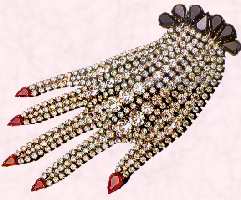 Highest grade Cubic
Zirconium man made imitation diamonds often set in precious metals is of such a
good standard that almost everyone can afford to have attractive jewellery.
The best crystals used in costume jewellery are the first grade crystals that the top Austrian firm Swarovski can offer. Butler and Wilson costume brooch.
Some of the costume jewellery I have come to love, comes from companies like Ciro, Adrian Buckley, Butler and Wilson, Swarovski Crystal Jewelry
Gems and Pearls Real and Fake
Jewels have always been used as love tokens and whilst many pieces were fine gems and precious metals, good fake jewellery intended to deceive existed. True gemstones and pearls originated from the east and were bought chiefly by the Italians. The Italian merchants then sold the goods on in Europe. Good glass imitations were often used and sometimes with intent as in royal funerary robes and children's jewellery.
Flawless, round, natural, large white pearls were prized more than precious gemstones. The finest of pearls were provided by South India and the Persian Gulf, see good examples of pearl jewellery. The Italians, particularly the Venetians and people from Murano, could make imitation glass gems and pearls that were very good likenesses of the real jewels. Recipes for false pearls existed in 1300 when white powdered glass mixed with albumen (egg white) and snail slime, produced beads that were used as imitation pearls.
Flawless, round, natural, large white pearls were prized more than precious gemstones. The finest of pearls were provided by South India and the Persian Gulf, see good examples of pearl jewellery. The Italians, particularly the Venetians and people from Murano, could make imitation glass gems and pearls that were very good likenesses of the real jewels. Recipes for false pearls existed in 1300 when white powdered glass mixed with albumen (egg white) and snail slime, produced beads that were used as imitation pearls.
订阅:
博文 (Atom)